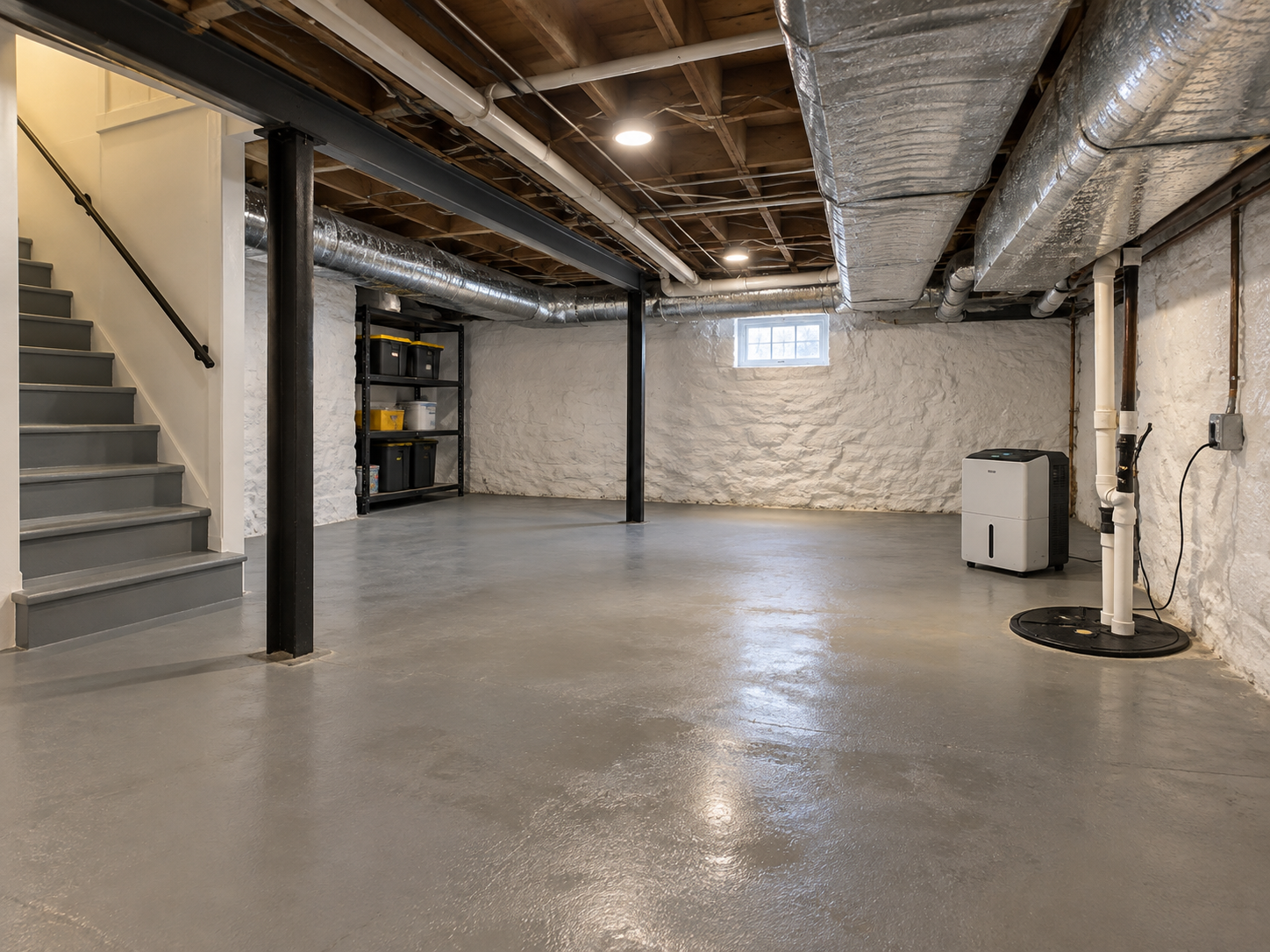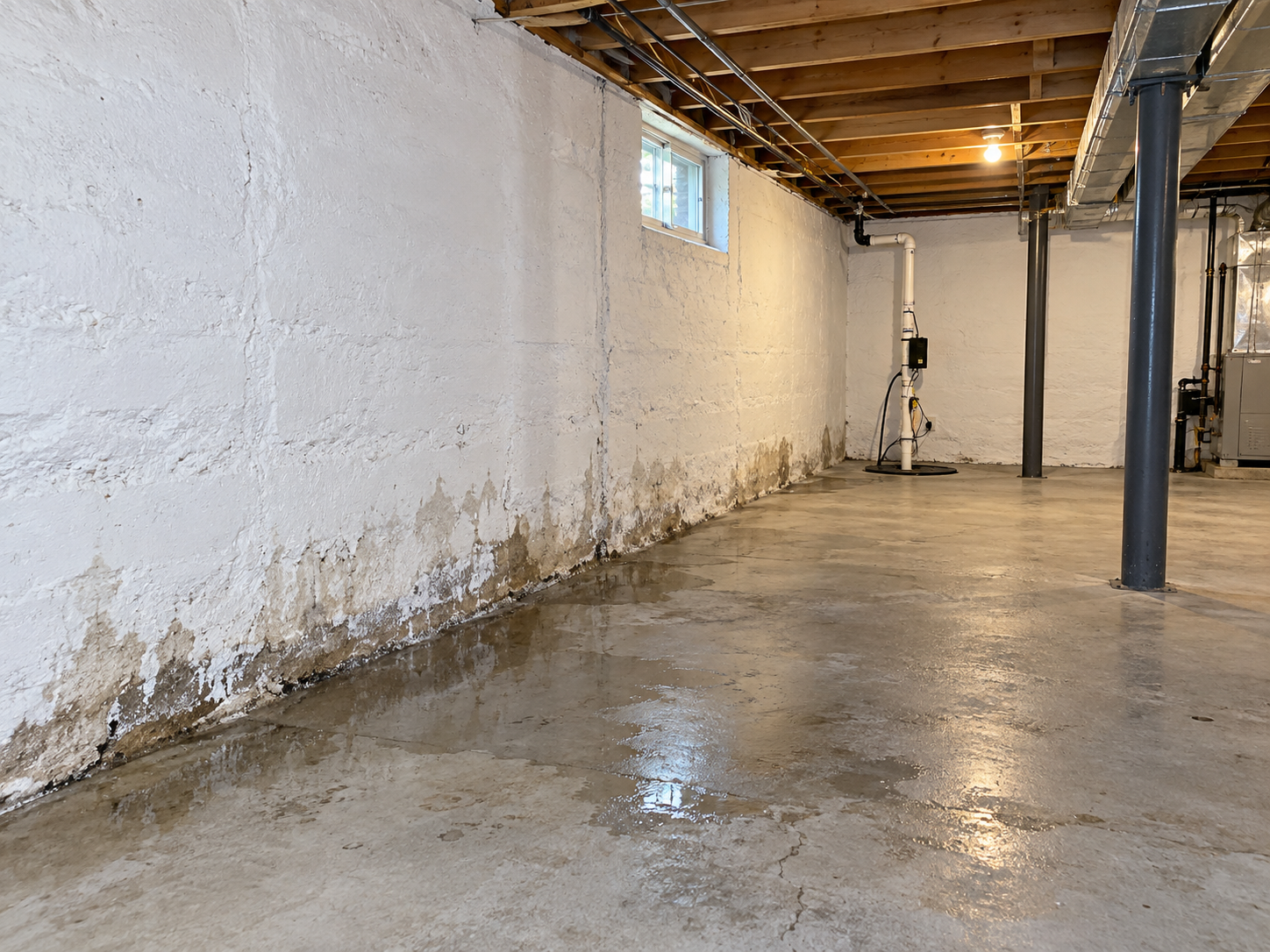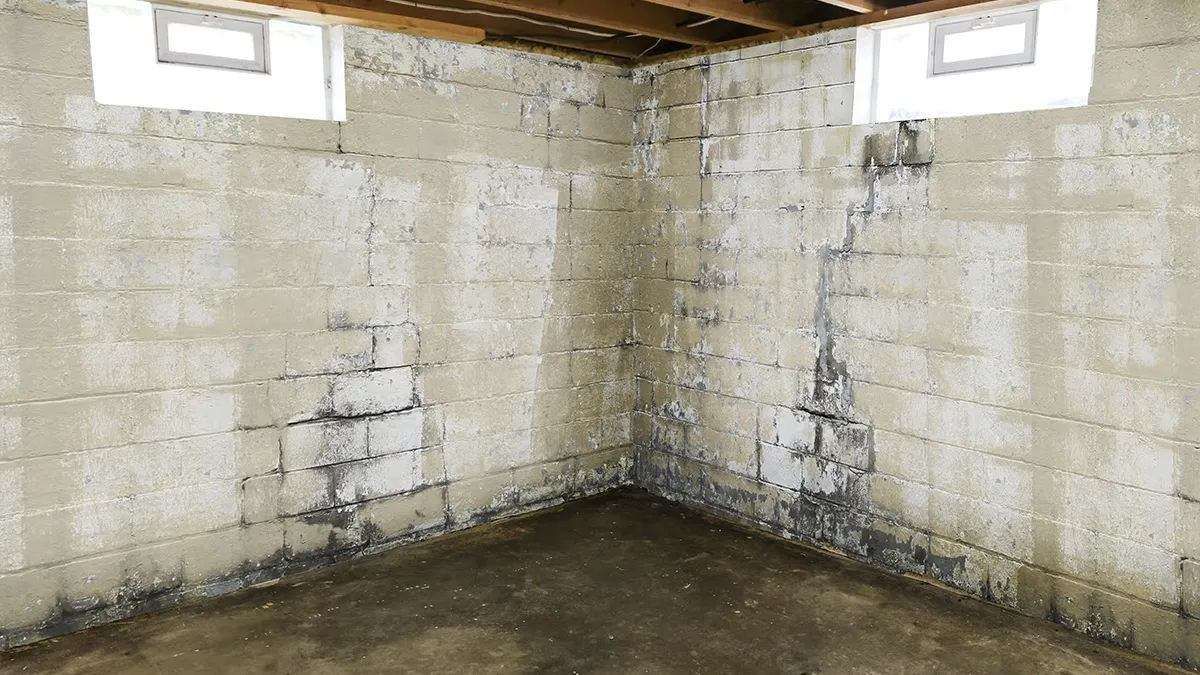
The most common signs your basement needs waterproofing are water on the floor after rain or snowmelt, a damp line where the wall meets the floor, wet patches on the walls, white chalky powder on concrete or stone, and a musty smell that never quite goes away. Some of these point to one crack or joint you can fix on its own. Others mean water is getting in from several places and needs to be managed. Where and when each sign shows up tells you which.
Water on the Floor After Rain or Snowmelt
This is the obvious one, and the most useful. Pay attention to when it happens. Water that shows up a few hours after a heavy rain, or during a thaw, is groundwater finding its way in.
If it only appears in one corner, look at what’s happening outside that corner first. A downspout emptying right next to the wall or soil sloping toward the house is often the whole story, and underground downspouts can fix it from the outside.
If it shows up in several spots, or along an entire wall, the water is coming from the saturated soil around the foundation. That’s the problem interior basement waterproofing is designed to handle.
A Damp Line Where the Wall Meets the Floor
Look at the seam where the basement wall meets the floor slab. In most poured concrete basements, that seam is a joint, not a solid connection, and it’s one of the first places water gets through when the ground outside is saturated.
A dark band along the bottom of the wall after rain, or a thin film of water creeping out from the edge, is a classic sign. Sealing that seam from the inside rarely holds for long, because the pressure behind it doesn’t go away. What works is giving the water somewhere to go: a drainage channel along the perimeter that carries it to a sump pump.
Damp or Dark Patches on the Walls
Wet-looking spots on concrete or block walls, especially low on the wall or in the same place after every storm, mean water is moving through the wall itself. Block walls are especially prone to this, because their hollow cores can fill with water and let it seep out through the face.
A quick test tells you whether you’re looking at water from outside or condensation from inside. Tape a square of aluminum foil over the damp spot, seal all four edges, and leave it for a day or two. If moisture shows up under the foil, it’s coming through the wall. If it’s on top, it’s condensation from humid basement air.
White, Chalky Powder on the Walls
That white, fuzzy or powdery residue on concrete, block or stone is called efflorescence. It’s mineral salts that water carries through the wall and leaves behind as it evaporates. It isn’t dangerous and it brushes off easily, but it keeps coming back, because the water keeps coming.
Think of it as a record. Even if you’ve never seen standing water down there, efflorescence tells you water has been moving through that wall, and exactly where. People sometimes mistake it for mold. A simple way to tell them apart: spray it with a little water. Efflorescence dissolves, mold doesn’t.
A Musty Smell, High Humidity or a Dehumidifier That’s Always Full
A basement doesn’t have to look wet to have a water problem. If it always smells musty, if stored boxes and clothes pick up that smell, or if the dehumidifier fills up every day, moisture is getting in somewhere, often through the walls and floor as vapor you’ll never see.
Left alone, that moisture feeds mold and mildew and drifts upstairs into the rest of the house. If part of your home sits over a crawlspace, check there too. A damp, vented crawlspace is often where the smell starts, and crawlspace encapsulation deals with it at the source.
A Crack That Gets Wet
Plenty of foundation cracks are harmless structurally. The real question is whether they leak. A damp line along the crack, a rust-colored stain, or efflorescence tracing its path all say water is using it.
A single leaking crack in poured concrete is usually a targeted repair, which is what our foundation crack repair service handles. If you’re not sure whether a crack is something to worry about, our guide to foundation cracks walks through what the different kinds mean.
Sand on the Floor or Crumbling Mortar
If your basement has fieldstone or older block walls and you keep finding sand or grit along the base, the mortar is washing out. Water carries it off a little at a time, and every gap it leaves lets more water in.
That’s a job for fieldstone foundation repointing, sometimes combined with waterproofing if water is also coming up from below. Our guide to fieldstone foundations covers what else to look for.
A Sump Pump That Never Stops or Can’t Keep Up
If you already have a sump pump, it’s one of the best early warning systems you’ve got. A pump that runs nonstop during a storm and still can’t lower the water, or a pit that overflows, means either the pump is failing or the amount of water coming in has outgrown it.
Start with a sump pump maintenance and inspection visit. If the pump is old or undersized, sump pump installation and replacement is the next step. And with winter coming, our guide on how to winterize your basement explains how a frozen discharge line can cause the same symptoms.
What Doesn’t Fix It
Two things get tried a lot, and they usually disappoint.
Waterproofing paint on the inside of the walls can help with light dampness, but it can’t hold back water pushing in from outside with real pressure behind it. The paint bubbles, peels, and the water is back, now with a flaking wall on top of it.
A dehumidifier is worth having in almost any basement, but it only treats the air. If water is coming through the walls or floor, it will keep filling up and you’ll keep emptying it.
Both treat the symptom. Waterproofing deals with where the water comes from and where it goes.
Planning to Finish the Basement? Deal With the Water First
This is where the most expensive mistakes happen. Drywall, carpet and framing hide every sign on this list, so a moisture problem that would have been simple to fix turns into mold behind a finished wall. If you’re thinking about basement finishing and remodeling, make sure the space is dry first. Fixing water in an unfinished basement costs far less than tearing out a finished one.
Seeing One of These Signs?
If any of this sounds familiar, call us at 508-498-1090 or request an inspection online. We’ll show you where the water is coming from and what it will take to fix it. If you’d like a sense of cost first, our page on basement waterproofing cost in Massachusetts covers what to expect.