Introduction
Yes. Poor exterior drainage can send water back toward a foundation when grading, downspouts, runoff paths, or underground drains fail to move water away. Over time, saturated soil can increase moisture against foundation walls and contribute to seepage, cracks, and basement dampness.
Author: All Pro Basement
Updated: October 21, 2026
A wet basement does not always begin inside the basement.
In many homes, the problem starts outdoors where rainwater, snowmelt, roof runoff, or sump discharge collects too close to the foundation.
Exterior drainage problems can quietly build moisture around the house before any water becomes visible indoors.
Can Poor Exterior Drainage Damage a Foundation?
Yes. Poor drainage can keep soil around the foundation wet for long periods.
That moisture can increase pressure against foundation walls and create conditions that encourage seepage.
The problem becomes more serious when soil repeatedly saturates after storms.
Over time, exterior drainage problems can also expose existing cracks or weak areas to more water.
How Does Water Get Trapped Near a Foundation?
Water becomes trapped when the property does not direct runoff away efficiently.
Common causes include poor grading, low spots, clogged drains, short downspouts, and settled soil.
Instead of moving away, water collects near the foundation and soaks into the soil.
Once the soil is saturated, additional water has fewer places to go.
What Is Negative Grading?
Negative grading means the ground slopes toward the house instead of away from it.
This directs surface runoff toward the foundation.
Even a small slope can influence where rainwater and snowmelt travel.
During heavy rain, negative grading can create concentrated wet zones beside basement walls.
This is one of the most common exterior drainage problems professionals look for during an inspection.
Can Poor Grading Cause Basement Water Problems?
Yes. Poor grading can increase the amount of water reaching foundation walls.
The water may not enter immediately.
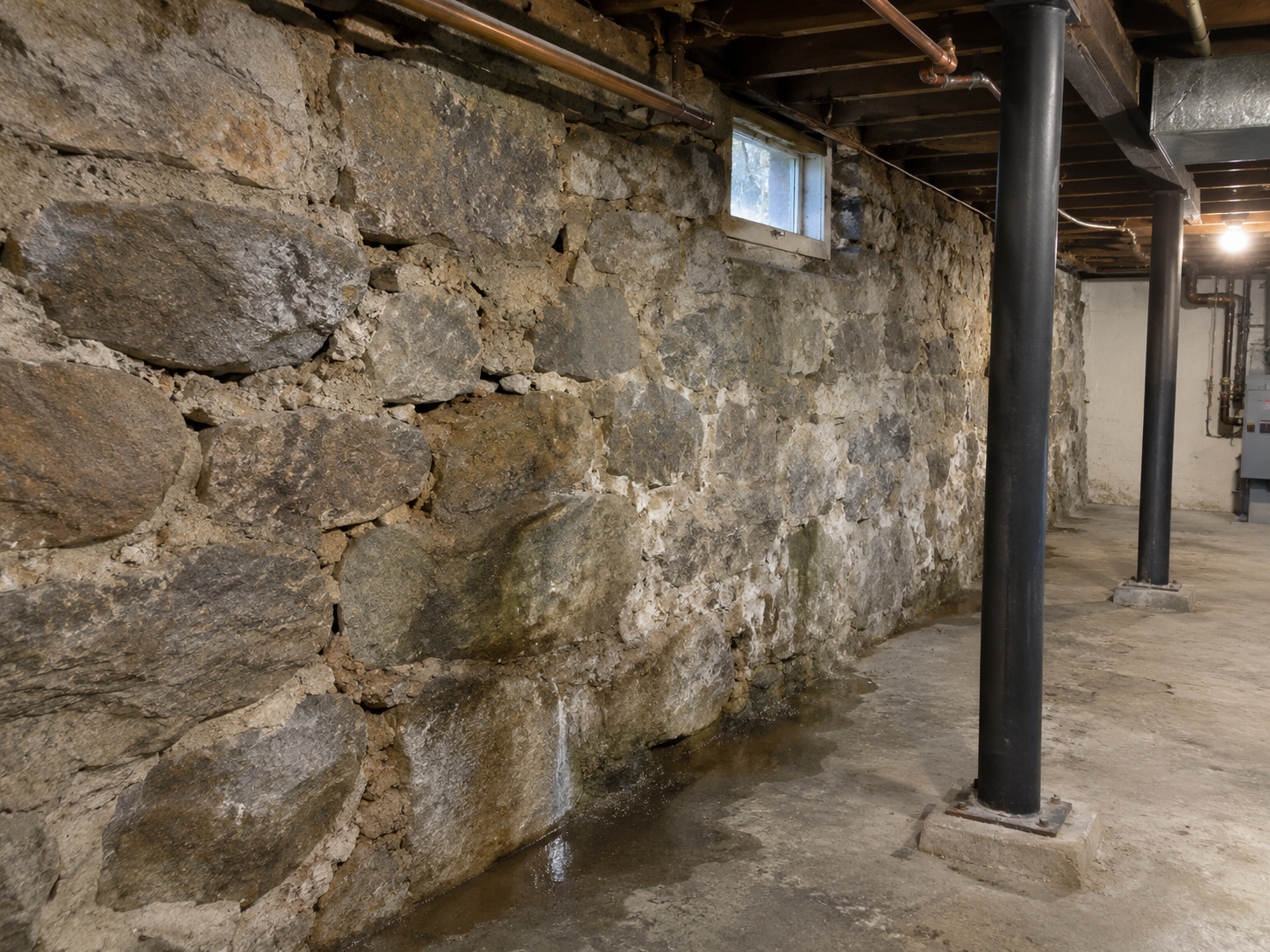
Instead, it can saturate the soil first and later move through cracks, joints, porous masonry, or other weak points.
This delay is why basement seepage can appear hours after the rain has ended.
Why Can a Yard Look Dry While the Soil Is Still Saturated?
The surface can dry faster than the deeper soil.
Sun and wind may remove moisture from the top layer while water remains trapped below.
As a result, the yard may appear normal even though saturated soil continues pressing moisture toward the foundation.
This is especially common after prolonged rain or spring snowmelt.
Can Downspouts Send Water Back Toward the House?
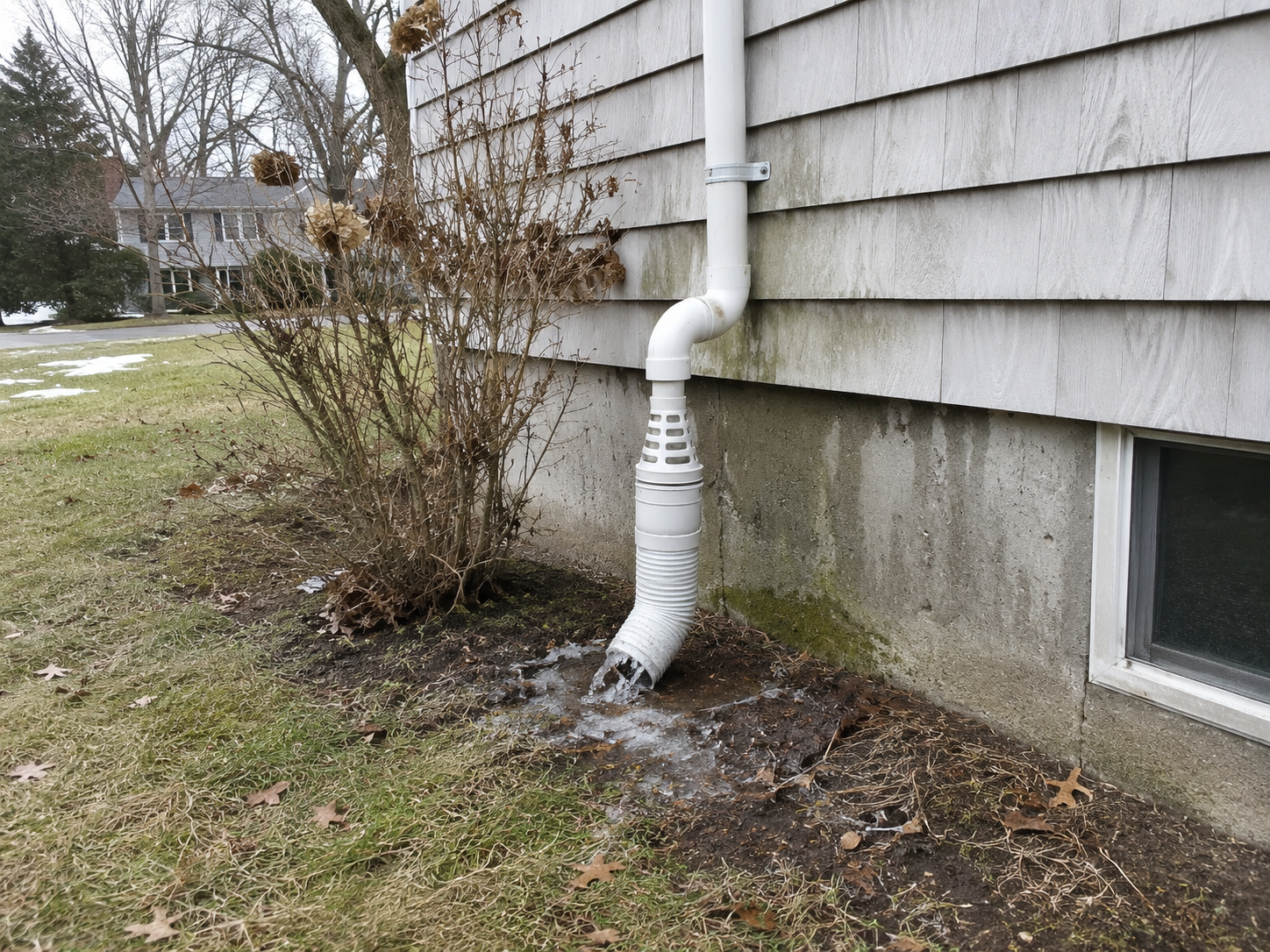
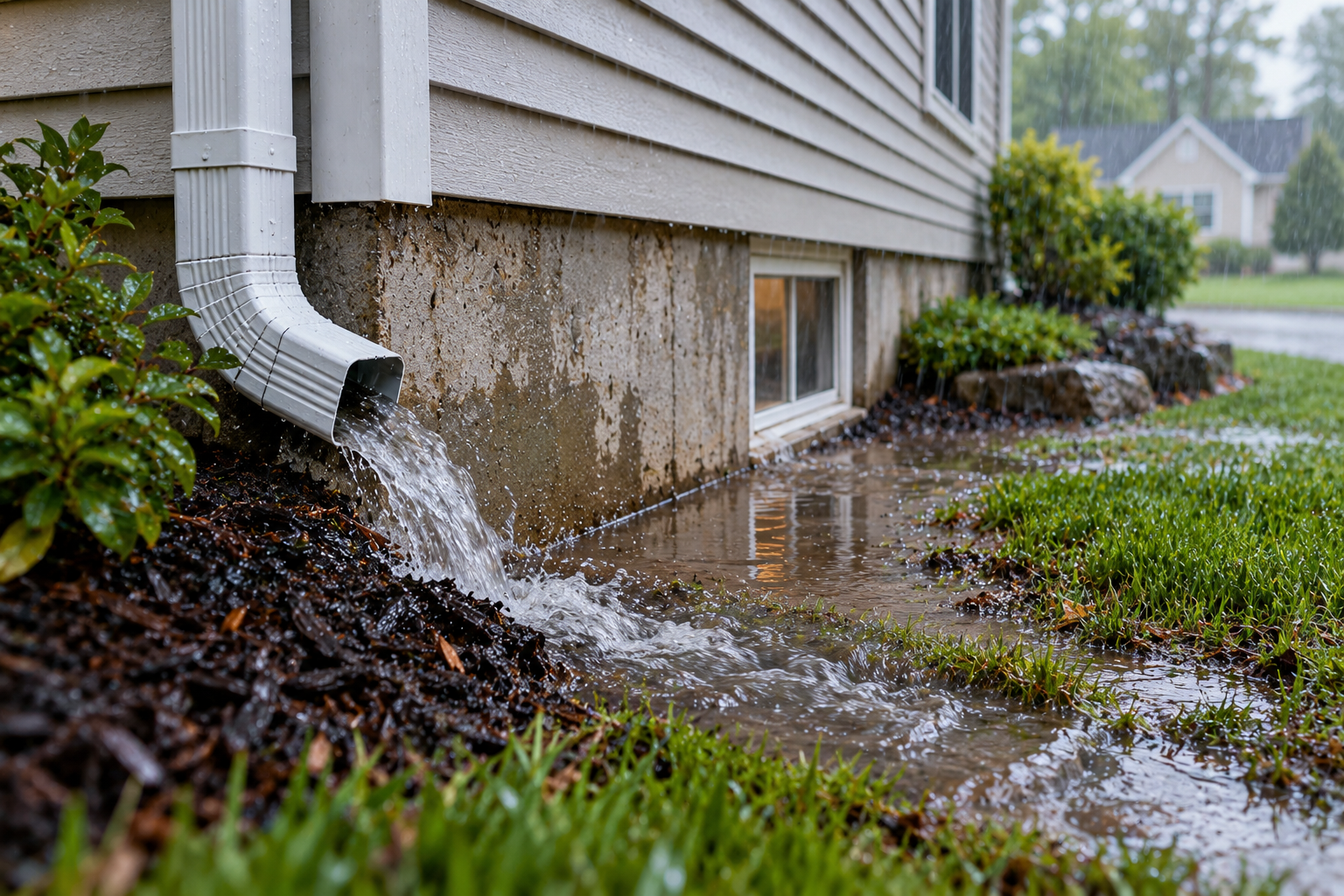
Yes. Downspouts that discharge too close to the foundation can concentrate roof runoff beside the home.
During a storm, a roof collects a large volume of water.
If that water is released near the wall, it can quickly saturate nearby soil.
Short or poorly routed downspouts can therefore contribute to exterior drainage problems.
Can Clogged Gutters Make Foundation Moisture Worse?
Yes. Clogged gutters can overflow and dump water next to the foundation.
Water may cascade directly onto the soil beside basement walls.
Repeated overflow can create localized saturation around corners and roof valleys.
Therefore, gutter condition should be part of a complete exterior drainage inspection.
Why Does Roof Runoff Matter So Much?
Roof runoff is concentrated water.
Instead of rain falling evenly across the yard, the gutter system collects water from the entire roof and sends it toward specific discharge points.
If those points are poorly placed, the foundation receives much more water than surrounding areas.
That makes downspout routing a critical part of exterior water management.
Can Low Spots Near the House Cause Problems?
Yes. Low spots can act like shallow basins that collect runoff.
Water may remain there long enough to soak deeply into the soil.
Low areas can develop after landscaping changes, erosion, or soil settlement.
They may also appear beside patios, walkways, or driveway edges.
Even small depressions can become important during repeated storms.
Can Soil Settlement Create New Drainage Problems?
Yes. Soil around foundations can settle over time.
When this happens, areas that once sloped away from the house may begin sloping back toward it.
The change can be gradual and easy to miss.
Older Massachusetts homes may develop exterior drainage problems even if the property originally drained correctly.
Can Driveway Runoff Reach the Foundation?
Yes. Driveways can channel large amounts of water toward the house if the slope is unfavorable.
Paved surfaces do not absorb much water.
Instead, runoff moves quickly along the surface.
If the driveway directs water toward the foundation, that flow can overload soil and nearby drainage.
Can Water From a Neighboring Property Affect My Foundation?
Yes. Water follows gravity and topography, not property lines.
A home located lower than nearby yards can receive runoff from surrounding land.
Changes to neighboring grading, patios, driveways, or drainage may also alter water flow.
This is why exterior drainage problems sometimes begin even when nothing changed on the homeowner’s own property.
What Happens When Soil Stays Saturated Near the Foundation?
Saturated soil holds more water against the foundation.
That increases the opportunity for moisture to reach cracks, joints, and porous materials.
It can also contribute to hydrostatic pressure beneath or beside the basement.
Building Science Corporation explains how below-grade foundations must manage both groundwater and surface water.
What Is Hydrostatic Pressure?
Hydrostatic pressure is pressure created by water in saturated soil.
When water builds around or beneath a foundation, it can push against foundation surfaces.
The pressure does not automatically mean a wall will fail.
However, it can increase the likelihood of seepage through existing cracks, joints, or floor-wall connections.
Can Exterior Drainage Problems Cause Foundation Cracks?
Poor drainage can contribute to conditions that stress a foundation, but not every crack is caused by water.
Soil movement, settlement, construction methods, and structural loading can also play a role.
Water becomes especially important when it changes soil conditions around the foundation.
A professional should evaluate both the crack and the drainage environment.
Can Underground Drainage Pipes Fail?
Yes. Underground drains can clog, collapse, disconnect, or become damaged.
Tree roots, sediment, soil movement, and aging materials can affect performance.
A drain may still exist underground while moving very little water.
That makes underground drainage problems harder to identify than visible gutter or grading issues.
How Can I Tell If an Underground Drain Is Clogged?
One clue is water collecting where the drain should be removing it.
You may also notice slow drainage, overflow at inlets, or unusually wet soil near the foundation.
However, underground conditions are difficult to confirm by appearance alone.
The outlet, pipe route, and surrounding soil may need further evaluation.
Can a Broken Drain Pipe Send Water Toward the Foundation?
Yes. A damaged underground pipe can release water before it reaches the intended outlet.
If the break is near the house, the drainage system may actually concentrate water beside the foundation.
This can make exterior drainage problems worse while giving the impression that the drain is still functioning.
Can Sump Pump Discharge Return Toward the Foundation?
Yes. A sump pump can remove basement water successfully and still create an exterior problem if the discharge ends too close to the house.
The discharged water may soak into nearby soil and eventually return to the drainage system.
This creates a recirculation loop.
The pump removes water, the discharge returns it outside, and the same moisture moves back toward the foundation.
How Can You Recognize Sump Discharge Recirculation?
Look for wet soil or pooling near the discharge outlet.
Frequent sump pump activity after the rain stops can also be a clue.
If the pump discharge ends on poorly graded ground, the water may flow directly back toward the house.
Discharge routing should be evaluated together with grading and soil conditions.
Can Interior Waterproofing Fix Exterior Drainage Problems?
Not completely.
Interior basement waterproofing can manage water that reaches the foundation or enters the basement.
However, it does not automatically correct poor grading, gutter overflow, or runoff outside.
Exterior drainage and interior waterproofing solve different parts of the water problem.
Some homes need only one approach.
Others may benefit from both.
Why Is Fixing Only One Downspout Sometimes Not Enough?
Because drainage problems are often connected.
A longer downspout extension may help one area while another low spot continues directing water toward the house.
Likewise, proper gutters cannot compensate for severe negative grading.
A professional should look at the entire exterior water path.
What Should a Professional Exterior Drainage Inspection Include?
A complete inspection should evaluate:
- Grading around the foundation
- Low spots near the house
- Gutter condition
- Downspout routing
- Surface runoff patterns
- Underground drains
- Drain outlets
- Sump pump discharge
- Driveway runoff
- Foundation cracks
Recent weather should also be considered.
How Do Professionals Separate Surface Water From Groundwater?
Surface water usually relates more directly to rain, gutters, grading, and runoff.
Groundwater may remain high even after the surface dries.
A professional compares timing, soil conditions, drainage behavior, sump activity, and basement symptoms.
This helps determine whether exterior drainage problems are the main cause or only one part of the issue.
Why Does Timing Matter During Diagnosis?
Timing can reveal where the water is coming from.
If seepage begins during a storm, surface runoff may be important.
If moisture appears many hours later, saturated soil or groundwater may be contributing.
If problems occur mainly during spring, snowmelt and seasonal groundwater may be involved.
Can Spring Snowmelt Cause Exterior Drainage Problems?
Yes. Snowmelt can release water over several days.
If the ground is frozen or already saturated, that water may have difficulty soaking in.
It can then move across the surface or collect near the foundation.
This is especially relevant in Massachusetts and other New England climates.
How Does Frozen Ground Change Drainage?
Frozen ground absorbs water differently than thawed soil.
Rain or melting snow may stay near the surface and follow slopes toward the house.
As a result, drainage patterns can change during winter and early spring.
A property that performs well in summer may develop exterior drainage problems during freeze-thaw conditions.
Can Heavy Rain Expose Problems That Normal Rain Does Not?
Yes. Some drainage systems work adequately during light rain but fail during intense storms.
A clogged pipe, low spot, or poor slope may not become obvious until runoff volume increases.
This is why homeowners often say a basement leaks only during certain storms.
The drainage system may be reaching its limit.
Can High Groundwater Make Exterior Drainage Problems Worse?
Yes. When groundwater is already elevated, soil has less capacity to absorb additional rain.
Surface runoff and underground moisture can combine.
This can increase the amount of water reaching the foundation.
In that situation, exterior drainage improvements may help reduce surface water while other systems manage groundwater.
What Warning Signs Should Homeowners Watch For?
Common signs include:
- Water pooling beside the house
- Overflowing gutters
- Downspouts ending near the wall
- Soil sloping toward the foundation
- Persistent wet spots
- Erosion near the house
- Basement stains
- Damp foundation walls
- Frequent sump pump activity
Several signs together provide stronger evidence than one symptom alone.
Why Is Exterior Water Management Important Before Major Repairs?
Because correcting the source of water can reduce pressure on every other foundation system.
If surface runoff is being directed toward the home, that problem should be understood before choosing a larger repair.
Exterior drainage problems can sometimes be improved with targeted corrections.
In other cases, underground drainage, foundation repair, or interior waterproofing may also be necessary.
How Does All Pro Basement Approach Drainage Diagnosis?
All Pro Basement evaluates exterior water movement together with foundation and basement conditions.
The goal is to identify where water starts, how it travels, and where it reaches the structure.
The company brings more than 25 years of hands-on experience with drainage, waterproofing, sump systems, and foundation repair in Massachusetts.
Owner Diego Tameirao personally oversees projects, while Project Manager Keila Tameirao helps coordinate homeowners throughout the process.
When exterior drainage problems are diagnosed correctly, the next step depends on grading, runoff, underground drainage, groundwater, discharge routing, foundation condition, and the actual path water is taking toward the home.
How Can I Tell If My Exterior Drainage Is Failing?
Exterior drainage may be failing when water repeatedly collects near the foundation, downspouts overflow, soil stays wet, or basement moisture appears after storms.
One sign alone may not prove the cause.
However, several drainage symptoms together can strongly suggest that water is not moving away from the house efficiently.
What Are the Most Common Signs of Poor Grading?
Poor grading often causes water to flow toward the foundation instead of away from it.
Homeowners may notice:
- Soil sloping toward the house
- Puddles beside foundation walls
- Erosion near corners
- Wet mulch beds
- Basement seepage after rain
- Downspout water flowing back toward the home
These clues can help identify exterior drainage problems before major water intrusion develops.
Can Underground Drainage Pipes Become Clogged?
Yes. Underground drain pipes can clog with sediment, debris, roots, or damaged pipe material.
When flow becomes restricted, water may back up near the foundation.
Some drainage systems appear normal at the surface even when the underground pipe is no longer carrying water efficiently.
That is why the outlet and pipe route should be checked.
Can a Broken Drain Pipe Send Water Toward the Foundation?
Yes. A cracked or disconnected underground drain can release collected water into the soil before it reaches the intended outlet.
If the failure is close to the house, the system may concentrate moisture beside the foundation.
This can make exterior drainage problems worse rather than better.
Does Every Drainage Problem Require Excavation?
No. Many exterior drainage problems can be improved without major excavation.
The correct repair depends on the source of the water and the condition of the existing system.
Possible corrections may include:
- Grading improvements
- Downspout extensions
- Gutter repairs
- Surface drainage
- Drain line cleaning
- Targeted pipe repair
Underground excavation is more appropriate when buried drainage itself is damaged or missing.
Where Should Downspouts Discharge?
Downspouts should release water where it can continue moving away from the foundation.
The exact location depends on grading, soil, property layout, and local drainage conditions.
The EPA recommends managing roof and surface water so it drains away from building foundations.
Simply adding a longer extension is not enough if the ground still slopes back toward the house.
Can Sump Pump Water Flow Back Toward the House?
Yes. Sump pump discharge can become part of an exterior drainage problem when it empties too close to the foundation.
Water may soak into nearby soil and return to the interior drainage system.
This creates unnecessary pump cycling and keeps the foundation zone wetter than it should be.
Proper discharge routing should work with the property’s slope.
How Can I Tell If Sump Water Is Recirculating?
Look for repeated wet soil around the discharge point and frequent sump activity after rainfall has stopped.
Another clue is water flowing downhill from the outlet toward the foundation.
A professional can compare discharge location, grading, sump cycling, and groundwater conditions to determine whether recirculation is occurring.
Can Driveway Runoff Affect Foundation Drainage?
Yes. Driveways can direct concentrated runoff toward the house.
Because pavement absorbs little water, rainfall moves quickly across the surface.
If the driveway slopes toward the foundation, runoff may collect beside basement walls or overwhelm nearby drains.
Drainage design should consider hard surfaces as well as soil.
Can Patios and Walkways Create Similar Problems?
Yes. Patios and walkways can change the way surface water moves around a property.
Settled sections may direct runoff toward the house.
Joints between hard surfaces and the foundation can also collect water.
These features should be included in a full exterior drainage inspection.
Can Snowmelt Overwhelm Exterior Drainage?
Yes. Spring snowmelt can release water over several days.
If the soil is frozen or already saturated, water may remain near the surface.
This can overwhelm low spots, drains, and grading around Massachusetts homes.
Exterior drainage problems often become most visible during late winter and early spring.
How Do Freeze-Thaw Cycles Change Drainage?
Freeze-thaw cycles can shift soil and change surface slopes.
They can also affect buried pipes, discharge lines, and drainage outlets.
A property that drained correctly in the past may develop new low spots after repeated seasonal movement.
That is one reason older New England properties should be evaluated periodically.
Can High Groundwater Make Exterior Drainage Repairs Less Effective?
Yes. Exterior drainage mainly manages surface and near-surface water.
If the water table is already high, groundwater may continue reaching the foundation even after runoff is improved.
In those conditions, interior drainage or sump systems may also be needed.
Exterior and interior systems manage different water sources.
When Is Underground Exterior Drainage Needed?
Underground exterior drainage may be appropriate when surface corrections cannot reliably move water away or when existing buried drains have failed.
It may also be useful when runoff repeatedly collects in predictable areas.
However, installation should follow diagnosis.
A new drain cannot solve poor grading if water never reaches the drain correctly.
Can Exterior Drainage Reduce Basement Seepage?
Yes. Reducing water near the foundation can reduce the amount of moisture available to enter cracks, joints, and porous masonry.
Exterior drainage problems should therefore be addressed when runoff is clearly contributing to basement seepage.
However, drainage alone may not stop water caused by high groundwater or interior foundation defects.
When Is Interior Waterproofing Also Necessary?
Interior waterproofing may be appropriate when groundwater or foundation seepage continues even after surface water is controlled.
Interior drainage systems collect water that reaches the foundation and direct it toward a sump system.
Building Science Corporation explains that effective below-grade moisture control often combines drainage with other water-management strategies.
The right approach depends on the actual path of the water.
Can Foundation Cracks Make Drainage Problems Worse?
Yes. Cracks can provide easier entry points when exterior soil remains saturated.
However, repairing a crack without correcting severe runoff may leave the surrounding water problem unchanged.
Likewise, drainage improvements will not restore a structurally significant crack.
Each condition should be evaluated separately.
Should Drainage Be Fixed Before Foundation Crack Repair?
Not always, but drainage should be evaluated before or alongside repair.
If runoff repeatedly saturates the same wall, correcting the exterior water source can reduce stress on the repaired area.
A complete plan should address both the opening and the moisture conditions surrounding it.
Can Basement Waterproofing Replace Exterior Drainage?
No. Basement waterproofing and exterior drainage serve different purposes.
Interior systems manage water that reaches the building.
Exterior drainage helps reduce the amount of water reaching the foundation in the first place.
Some homes need only one solution.
Others benefit from both because they have multiple water sources.
Why Can a New Drain Fail to Solve the Problem?
A new drain may fail if the property still sends water toward the house.
Negative grading, clogged gutters, short downspouts, or driveway runoff can continue saturating the foundation zone.
The drain itself must also have a clear outlet.
Exterior drainage problems are best treated as a complete water-flow system.
What Should Be Checked Before Installing Underground Drainage?
A professional should inspect:
- Property slope
- Soil conditions
- Runoff paths
- Downspout locations
- Drain outlets
- Existing buried pipes
- Foundation type
- Basement symptoms
- Groundwater
- Sump discharge
These details help determine whether underground drainage is actually the right solution.
How Does Soil Type Affect Drainage?
Different soils absorb and transmit water differently.
Some soils drain quickly, while others hold moisture longer.
A drainage strategy should account for how water actually moves through the property.
That is why the same exterior drainage repair may perform differently from one home to another.
How Can Exterior Drainage Problems Affect Older Homes?
Older homes may have settled soil, aging drains, older gutters, fieldstone foundations, or previous landscaping changes.
These factors can gradually alter water movement.
Massachusetts properties may also have drainage systems installed decades ago that no longer perform as intended.
Older construction deserves a whole-property evaluation rather than a single repair assumption.
When Should I Call a Drainage Professional?
Call a professional when water repeatedly pools near the foundation, basement seepage follows storms, or drainage behavior changes without an obvious reason.
Professional evaluation is also useful when:
- Underground drains are suspected
- Sump discharge returns toward the home
- Grading is unclear
- Foundation cracks are present
- Multiple runoff sources overlap
The goal is to identify the actual path of water before choosing repairs.
How Does All Pro Basement Diagnose Exterior Drainage Problems?
All Pro Basement evaluates surface runoff, grading, buried drainage, foundation conditions, sump discharge, and basement symptoms together.
The company is family-owned and operated with more than 25 years of hands-on experience.
Diego Tameirao personally oversees projects, while Project Manager Keila Tameirao helps coordinate homeowners throughout the process.
The approach emphasizes honest evaluation without high-pressure sales.
A homeowner may need a simple grading correction, drainage repair, foundation work, sump improvement, or waterproofing.
Not every property needs every service.
Frequently Asked Questions About Exterior Drainage Problems
How Do I Know If I Have Exterior Drainage Problems?
Look for recurring water near the foundation, negative grading, overflowing gutters, wet soil, downspouts that discharge too close to the house, or basement seepage after storms.
Several of these signs together make a drainage problem more likely.
Can Poor Grading Cause Water in My Basement?
Yes. Poor grading directs runoff toward the foundation.
That water can saturate the soil and eventually enter through cracks, joints, or other openings.
The leak may appear during the storm or several hours later.
Can Clogged Exterior Drains Cause Basement Leaks?
Yes. A clogged drain can allow water to accumulate near the foundation.
If the surrounding soil becomes saturated, moisture may reach basement walls or floor joints.
Clearing the blockage may help when the drain is otherwise properly designed.
Why Does Water Collect Near My Foundation After Rain?
Water may collect because of negative grading, low spots, blocked drainage, gutter overflow, or downspouts that release water too close to the house.
Soil settlement can also create new depressions over time.
The pattern of pooling usually offers important clues.
Can Sump Pump Discharge Cause Water to Come Back?
Yes. If the discharge outlet ends too close to the home or on ground that slopes back toward the foundation, pumped water can return through the soil.
This may contribute to repeated sump cycling and foundation moisture.
Will Exterior Drainage Stop Basement Seepage?
It can reduce seepage when surface runoff is the main source.
However, groundwater, cracks, floor-wall joints, or porous masonry may still allow moisture indoors.
A complete diagnosis should determine whether exterior drainage problems are the only cause.
Do I Need Underground Drainage Around My House?
Not automatically.
Underground exterior drainage is appropriate only when the property’s water patterns justify it.
Some homes improve significantly with grading or downspout corrections.
Others require buried drainage because surface measures alone cannot manage runoff.
Should I Fix Drainage Before Waterproofing My Basement?
Exterior drainage should be evaluated before or alongside basement waterproofing.
Reducing unnecessary water near the foundation can lower the load on the interior system.
However, high groundwater may still require interior drainage and a sump pump.
What Is the Best Long-Term Drainage Strategy?
The best strategy controls water before it becomes a basement problem.
That may involve roof runoff, grading, surface drainage, underground drains, sump discharge, interior drainage, or foundation repairs.
Exterior drainage problems should not be treated as one isolated pipe or puddle.
The entire path from rainfall to final discharge should be considered.
For Massachusetts homes, that path can change with spring snowmelt, saturated soil, frozen ground, heavy rain, and seasonal groundwater.
A durable solution should account for those conditions.
Contact All Pro Basement Today to find out whether exterior drainage problems are sending water back toward your foundation and which drainage, waterproofing, or foundation solution best fits your property.