Introduction
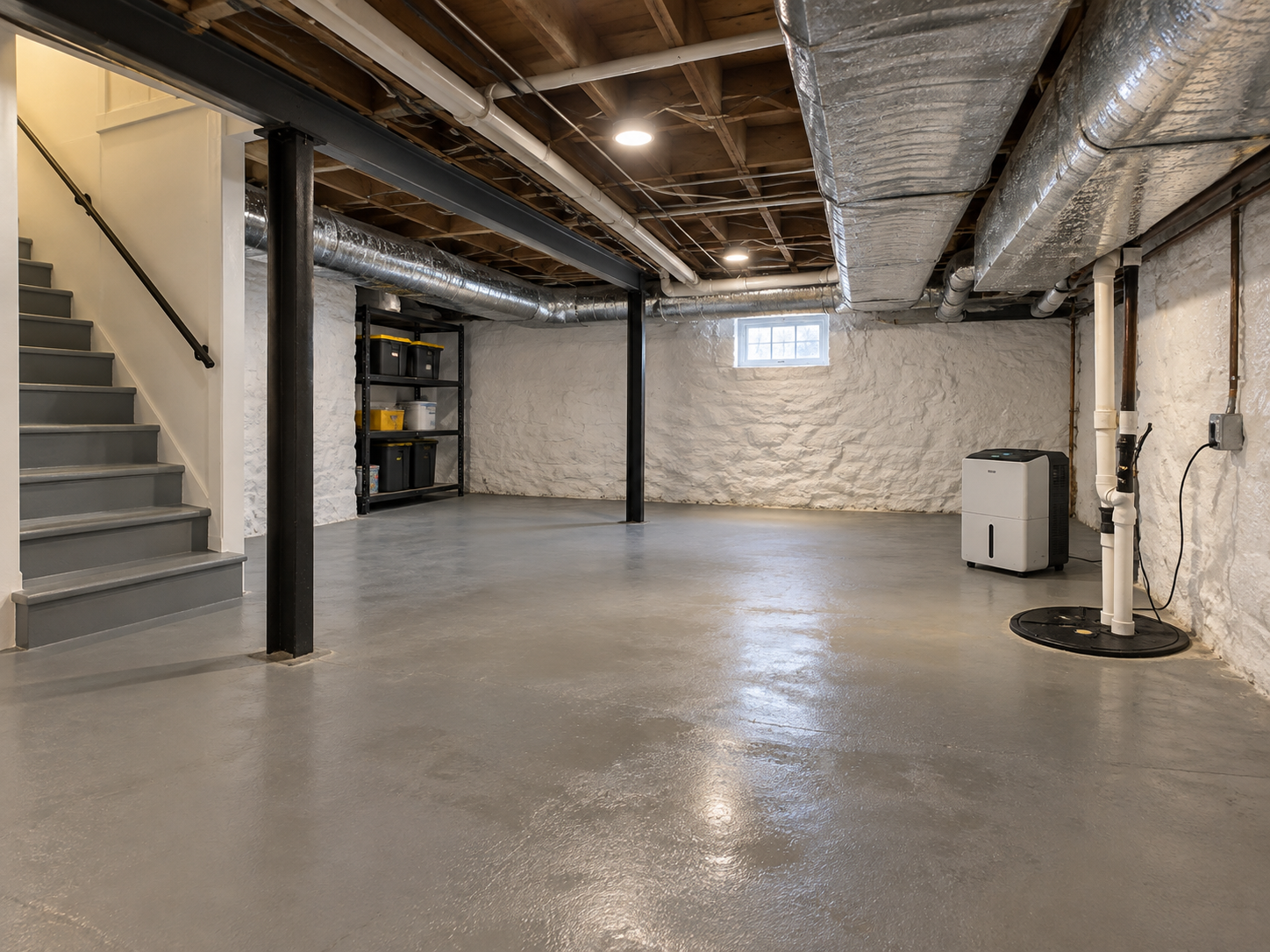
A basement can get wet without recent rain because groundwater moves slowly through soil, hydrostatic pressure can remain after storms, and high water tables may push moisture toward the foundation. Plumbing leaks, condensation, poor drainage, foundation cracks, and delayed snowmelt can also cause water intrusion.
Finding water in your basement on a dry day can be confusing. However, the weather outside does not always reveal what is happening beneath your home.
Water may remain stored in saturated soil for days. Meanwhile, groundwater can continue moving toward your foundation long after the clouds disappear.
That is why effective basement waterproofing begins with identifying where the moisture originates rather than assuming every wet basement is caused by current rainfall.
How Can a Basement Get Wet Without Recent Rain?
A basement can become wet without recent rain when water already stored underground reaches the foundation or when moisture comes from a source unrelated to weather.
Basements sit below grade and remain in contact with soil. Consequently, underground conditions may affect them long after surface conditions appear dry.
The U.S. Environmental Protection Agency identifies groundwater, surface runoff, plumbing leaks, condensation, and melting snow or ice as possible sources of building moisture.
Several hidden causes may explain basement water on a sunny day:
- Groundwater moving slowly through saturated soil
- A temporarily elevated water table
- Hydrostatic pressure beneath the slab
- Foundation cracks or joints
- Poor exterior grading
- Plumbing leaks
- Condensation on cool basement surfaces
- Delayed snowmelt entering the soil
Therefore, diagnosing a wet basement requires looking beyond today’s forecast.
Can Groundwater Enter a Basement Days After a Storm?
Yes. Groundwater can continue moving through soil after rainfall has stopped, so basement water may appear hours or even days later.
The timing depends on soil conditions, drainage, elevation, groundwater levels, and how easily water can move toward the foundation.
For example, soil around a home may become heavily saturated during several rainy days.
Even after the surface dries, moisture deeper in the soil can continue traveling downward and sideways.
As a result, a homeowner may discover basement water on a bright afternoon and assume the leak is new.
In reality, the water may be the delayed result of earlier precipitation.
This delayed movement is one reason basement waterproofing should address water management around and beneath the foundation instead of focusing only on visible cracks.
What Is Hydrostatic Pressure?
Hydrostatic pressure occurs when groundwater accumulates around or beneath a foundation and creates pressure against walls, footings, joints, or the basement floor.
Water naturally seeks a path through available openings.
Therefore, cracks, wall-floor joints, porous masonry, pipe penetrations, and imperfections in concrete can become entry points.
Building Science Corporation explains that accumulated groundwater can create pressure that pushes water through foundation joints, cracks, and imperfections.
Building Science Corporation Foundation Water Guidance
The key issue is not simply whether a foundation has an opening.
The larger issue is why water is accumulating against that opening.
A crack repair may stop one pathway. However, if hydrostatic pressure remains, water may eventually find another weak point.
Therefore, professional basement waterproofing often focuses on managing the water itself in addition to sealing vulnerable areas.
What Are the Signs of Hydrostatic Pressure?
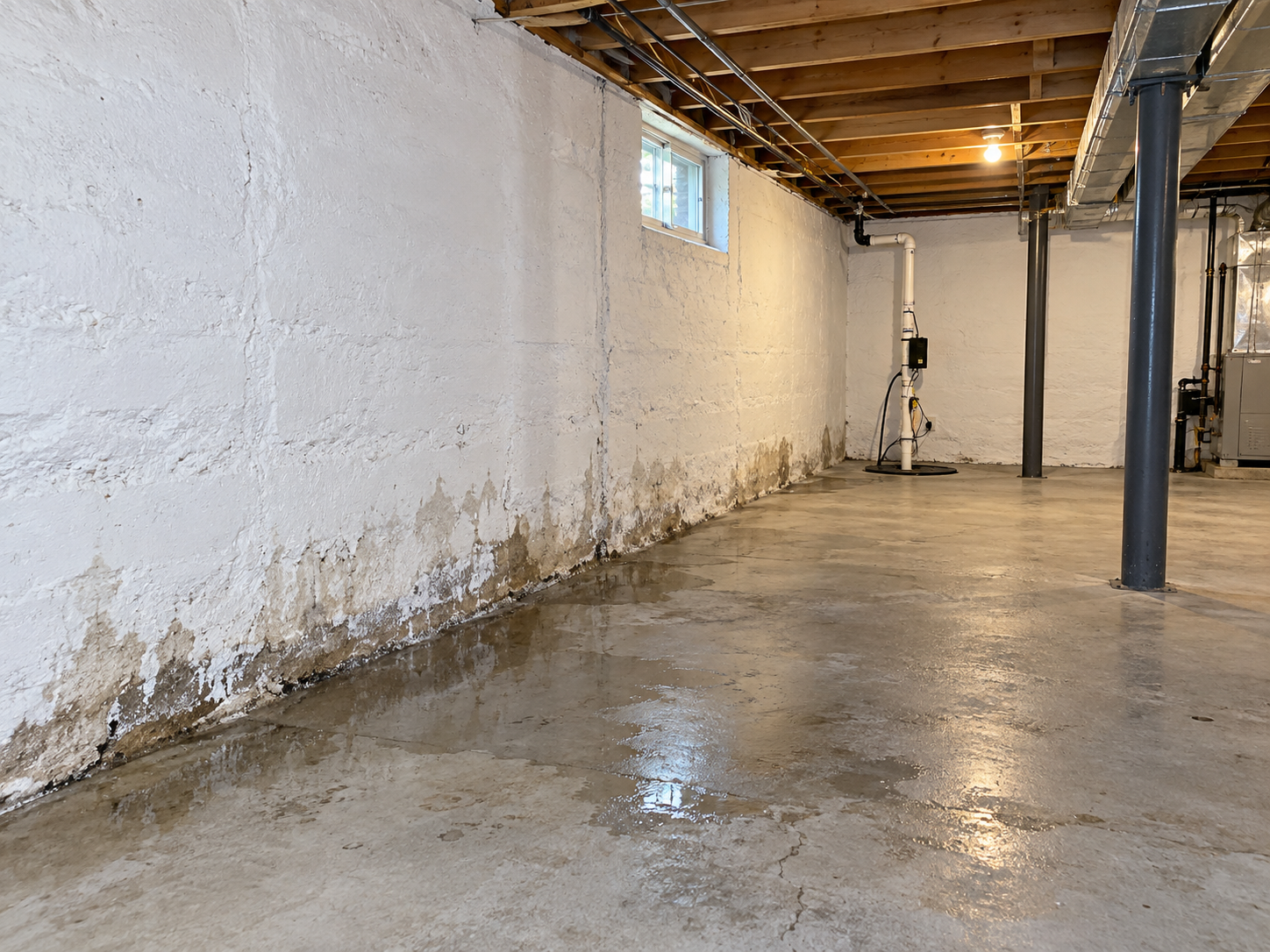
Water appearing near the wall-floor joint or rising through cracks in the slab can suggest pressure from groundwater.
Other possible signs include:
- Dampness along the basement perimeter
- Water emerging from floor cracks
- Efflorescence on masonry
- Repeated puddles in the same area
- Moisture returning after cleanup
- Water appearing after prolonged wet periods
- A sump pump running frequently
Efflorescence is the white, powdery mineral residue sometimes visible on concrete or masonry.
It can indicate that moisture has moved through the material and left mineral deposits behind as the water evaporated.
However, no single sign proves hydrostatic pressure.
The pattern, timing, location, soil conditions, and drainage system should be evaluated together.
Can a High Water Table Cause Basement Water?
Yes. If groundwater rises near or above the basement floor elevation, water pressure can develop beneath the slab and around foundation walls.
A water table is the underground level where soil becomes saturated with water.
That level is not always constant.
It can rise seasonally because of precipitation, snowmelt, local drainage conditions, and surrounding groundwater patterns.
This matters in Massachusetts, where seasonal moisture conditions can change significantly throughout the year.
A basement that stays dry during one season may behave differently during spring snowmelt or extended wet periods.
Therefore, basement waterproofing systems in New England should account for recurring groundwater conditions rather than treating every leak as an isolated event.
Can Snowmelt Cause Basement Water When It Is Not Raining?
Yes. Melting snow can saturate soil around a foundation even when no rain is falling.
This can be especially important after a significant snow accumulation followed by warmer temperatures.
The EPA includes melting snow, ice, and frost among exterior sources of building moisture.
Snowmelt may enter the soil gradually.
Consequently, basement moisture can appear well after the visible snow begins disappearing.
Frozen or partially frozen ground may also affect how water drains across a property.
Instead of soaking evenly into the soil, meltwater may collect in certain areas near the foundation.
In Massachusetts, freeze-thaw conditions can make this pattern particularly important when evaluating recurring basement water.
How Do Freeze-Thaw Cycles Affect a Foundation?
Freeze-thaw cycles can worsen existing foundation weaknesses by repeatedly exposing materials and joints to changing temperatures and moisture.
Water can enter small cracks or deteriorated mortar.
When conditions repeatedly freeze and thaw, already vulnerable masonry may continue deteriorating over time.
Older Massachusetts homes with fieldstone foundations require special attention because mortar joints and irregular stone assemblies behave differently from modern poured concrete walls.
Moisture may move through deteriorated joints even when no obvious crack is visible.
For that reason, basement waterproofing in an older home may require evaluating both water management and the condition of the masonry.
Could Water Be Coming From Below the Basement Floor?
Yes. Water can enter through cracks, joints, or openings in the slab when groundwater accumulates beneath the basement floor.
Concrete may look solid, but a basement slab is not automatically a waterproof barrier.
Building Science Corporation notes that foundation systems need to control groundwater, capillary movement, and water vapor.
Building Science Corporation Basement Foundation Guidance
One common entry point is the joint where the basement floor meets the foundation wall.
This area can become noticeable when groundwater pressure increases.
Small slab cracks may also reveal moisture.
However, sealing the visible crack alone may not solve an underlying groundwater problem.
An interior drainage system can be designed to collect water before it spreads across the basement floor and direct it toward a sump system.
The appropriate solution depends on the actual water source and foundation configuration.
Could Poor Exterior Drainage Cause Water on a Dry Day?
Yes. Poor grading, downspout discharge, clogged drainage systems, or water collecting near the foundation can saturate soil that remains wet long after rainfall ends.
Exterior drainage affects how much water reaches the soil beside the basement.
Building Science Corporation recommends directing roof and surface water away from foundation perimeters and using grading that slopes away from the building.
The EPA likewise recommends managing surface water so it does not accumulate around the foundation.
A simple inspection outside may reveal clues such as:
- Soil sloping toward the house
- Downspouts ending beside the foundation
- Low areas where water collects
- Sunken landscaping
- Poorly drained patios or walkways
- Underground drains that no longer function properly
However, correcting exterior drainage does not automatically solve every wet basement.
If groundwater is already reaching the foundation from deeper soil, additional basement waterproofing measures may be necessary.
Can Foundation Cracks Leak When It Has Not Rained?
Yes. A foundation crack can leak whenever moisture remains in the surrounding soil, even if current weather is dry.
Cracks create pathways, but the surrounding water conditions determine when those pathways become active.
For example, a vertical concrete crack may remain dry for weeks.
After groundwater rises, the same crack may begin leaking even though the most recent storm has already passed.
Likewise, deteriorated mortar in a fieldstone foundation can allow moisture to migrate through multiple small openings.
A professional inspection looks at the crack pattern, location, wall condition, surrounding drainage, and signs of previous water movement.
That distinction matters because structural foundation crack repair and basement waterproofing solve different parts of the problem.
Could the Water Actually Be a Plumbing Leak?
Yes. Plumbing leaks can create basement water that has nothing to do with rainfall or groundwater.
A leaking supply line, drain pipe, water heater, appliance connection, or fixture above the basement may send water downward.
Plumbing leaks often create different patterns from groundwater.
Possible clues include:
- Moisture beneath plumbing lines
- Water appearing after showers or laundry
- A localized wet ceiling or wall
- Water near a water heater
- Dampness unrelated to seasonal weather
- Repeated moisture in one isolated area
However, hidden plumbing can make diagnosis difficult.
For example, water may travel along framing before becoming visible several feet away from the actual leak.
That is why the location of the puddle does not always identify the source.
How Can I Tell Groundwater From a Plumbing Leak?
Timing and location provide some of the strongest clues.
Groundwater problems often correspond with seasonal saturation, snowmelt, prolonged rain, or elevated groundwater conditions.
Plumbing leaks may correspond with water use inside the home.
A useful first step is observing when the moisture appears.
If water increases after someone uses a shower or washing machine, plumbing deserves closer inspection.
If water appears near the floor perimeter after long wet periods, groundwater becomes more likely.
However, homes can have more than one moisture source at the same time.
Therefore, assumptions can lead to the wrong repair.
All Pro Basement approaches basement water diagnosis by identifying how water is reaching the structure before determining which drainage, sump pump, crack repair, or basement waterproofing strategy fits the conditions.
Could Condensation Make My Basement Look Like It Is Leaking?
Yes. Condensation can create damp walls, pipes, floors, or other cool surfaces without groundwater actually entering the basement.
Warm, humid air can release moisture when it contacts a cooler surface.
The EPA explains that condensation can occur on cool foundation materials and recommends controlling indoor humidity as part of moisture management.
EPA Home Moisture Guidance
Condensation often appears differently from active water intrusion.
Instead of a defined stream or puddle from one opening, surfaces may feel generally damp.
Cold water pipes may sweat.
Walls can feel moist during warm, humid weather.
Basement moisture can also have multiple causes at once.
For example, a basement may have elevated humidity while groundwater is also affecting one section of the foundation.
That is why distinguishing vapor, condensation, plumbing water, and groundwater is an essential step before choosing a repair.
How Can I Find Where Basement Water Is Coming From?
Start by identifying where the water first appears, when it returns, and what conditions occur before it becomes visible.
Do not rely only on the largest puddle. Water can travel along walls, floors, pipes, framing, or foundation joints before collecting in another location.
Therefore, the wettest area may not be the actual entry point.
A practical inspection should look for patterns such as:
- Water along the wall-floor joint
- Damp foundation cracks
- Moisture beneath plumbing
- Wet spots near a sump pit
- White mineral deposits
- Damp fieldstone mortar
- Water emerging through slab cracks
- Condensation on pipes or walls
Timing also matters.
If moisture appears during snowmelt or after several saturated days, groundwater becomes a stronger possibility.
If it appears after showers, laundry, or fixture use, plumbing should be investigated.
Meanwhile, widespread dampness during humid weather may point toward condensation rather than bulk water intrusion.
This is why proper basement waterproofing starts with diagnosis instead of automatically sealing the first visible crack.
Why Does Identifying the Water Source Matter?
Different sources require different repairs. A solution designed for groundwater will not repair a plumbing leak, while a dehumidifier cannot stop water being forced through a foundation joint.
For example, condensation may require humidity control and better insulation strategies.
Groundwater may require drainage and sump management.
A structural crack may require an appropriate foundation repair.
Poor grading may require changes outside the home.
Therefore, identifying the mechanism behind the water can prevent homeowners from spending money on repairs that never address the real cause.
The U.S. EPA recommends managing both rainwater and groundwater around foundations rather than treating moisture as a single problem.
Could My Sump Pump Be Part of the Problem?
Yes. A sump pump that is undersized, obstructed, aging, poorly installed, or unable to discharge water correctly may allow groundwater to accumulate around or beneath the basement.
The sump system works with drainage components that collect water and direct it into the sump basin.
The pump then moves that water to an approved discharge location.
If any part of that process fails, water levels may rise.
Warning signs can include:
- Frequent cycling
- Unusual pump noises
- A pump that never activates
- Standing water in the sump pit
- Water returning after pumping
- Discharge water flowing toward the house
- Basement water during power outages
A pump should not be judged only by whether its motor turns on.
Its capacity, discharge route, check valve, basin, drainage connection, and backup protection also matter.
FEMA identifies sump pumps as a defense against basement seepage and recommends battery-operated backup protection for power failures.
That recommendation is especially relevant during severe weather because the conditions that increase groundwater can also interrupt electrical service.
Why Is a Battery Backup Important?
A battery backup can keep a properly designed sump system operating when household electricity is unavailable.
Without backup protection, a functioning primary pump may become useless during an outage.
This creates a frustrating situation: the drainage system continues collecting groundwater while the pump that normally removes it cannot operate.
However, battery backup systems still require proper sizing, installation, maintenance, and inspection.
They should be treated as part of a water-management strategy rather than a substitute for proper basement waterproofing.
When Does a Basement Need an Interior Drainage System?
An interior drainage system may be appropriate when groundwater repeatedly reaches the basement perimeter or accumulates beneath the slab.
The system is designed to collect water and direct it toward a sump basin before it spreads across the basement.
This approach can be useful when hydrostatic pressure repeatedly affects the wall-floor joint or other low foundation areas.
However, not every damp basement requires an interior drainage system.
A plumbing leak should be repaired at the plumbing source.
Condensation may require humidity control.
Surface water may require grading or drainage corrections.
Therefore, the system should match the actual cause.
A professional basement waterproofing evaluation should determine whether interior drainage addresses the water pathway found during inspection.
How Does an Interior Drainage System Manage Groundwater?
Interior drainage systems create a controlled pathway for water that reaches the foundation.
Instead of allowing groundwater to emerge unpredictably through joints or cracks, the system directs it toward a collection point.
A sump pump can then remove the collected water from the basement area.
This does not mean groundwater disappears from the surrounding soil.
Instead, the system manages where the water travels once it reaches the foundation.
That distinction is important because permanent basement waterproofing is often about controlling water movement rather than attempting to make surrounding soil permanently dry.
Can Exterior Drainage Improvements Help?
Yes. Managing roof runoff and surface water can reduce the amount of water saturating soil beside a foundation.
Gutters, downspouts, grading, and underground exterior drainage may all play a role depending on the property.
The U.S. Department of Energy’s Building Science Education program recommends directing roof water away from foundations to reduce soil saturation and basement moisture risks.
Exterior improvements are particularly important when downspouts discharge beside the house or when the ground slopes toward the foundation.
However, groundwater may originate beyond the immediate roof drainage area.
Therefore, exterior corrections and basement waterproofing may sometimes work together rather than serving as competing solutions.
Can Foundation Crack Repair Stop Basement Water?
Foundation crack repair can stop water entering through a specific crack when that crack is the identified pathway.
However, repairing one crack does not automatically solve a broader groundwater problem.
Consider a basement where hydrostatic pressure affects several sections of the foundation.
Sealing one opening may close that pathway, but pressure can remain around the structure.
Water may then appear through another vulnerable joint or crack.
For this reason, foundation crack repair should be based on both the condition of the crack and the moisture conditions surrounding it.
Structural concerns should also be distinguished from ordinary water intrusion.
A qualified inspection can determine whether the issue is primarily drainage-related, structural, or a combination of both.
What About Fieldstone Foundations?
Fieldstone foundations require a different diagnostic approach because moisture can travel through aging mortar joints and irregular masonry pathways.
Older homes throughout Massachusetts commonly contain this type of foundation.
Mortar can deteriorate over time, leaving joints that allow moisture movement.
Meanwhile, water may also enter at the footing level or through areas affected by poor drainage.
Repointing can restore deteriorated mortar where appropriate.
However, repointing alone may not control significant groundwater pressure around the foundation.
In those situations, masonry repair and basement waterproofing may need to address separate parts of the same moisture problem.
Should I Simply Seal the Basement Walls?
Not necessarily. Applying a coating to an interior wall does not automatically eliminate the source of water behind it.
The correct strategy depends on whether moisture is caused by vapor, condensation, groundwater, plumbing, surface runoff, or another pathway.
Water under pressure may continue seeking an opening even when one surface has been coated.
Therefore, coatings should not replace a complete moisture diagnosis.
The Department of Energy’s Building Science Education resources emphasize comprehensive foundation water management, including drainage, moisture barriers, and water-resistant assemblies.
Why Does My Basement Get Wet Days After Rain?
Delayed basement water usually occurs because the ground remains saturated after surface rainfall has ended.
Water continues moving through soil and can gradually raise groundwater levels near the foundation.
Soil conditions influence how quickly this happens.
The foundation may remain dry during the storm but begin leaking later as groundwater pressure increases.
This is also why checking only the weather from the day water appears can lead to the wrong conclusion.
Look at conditions over the previous several days, including rain, snowmelt, temperature changes, and ground saturation.
What Should I Do When I Discover Basement Water?
First, protect people and property while observing where the water appears to originate.
Avoid electrical hazards in wet areas and move vulnerable belongings away from moisture when it is safe to do so.
Then document the conditions.
Helpful information includes:
- Where the water first appeared
- When you noticed it
- Recent weather conditions
- Whether snow was melting
- Whether the sump pump was running
- Whether plumbing had recently been used
- How quickly the water returned
Photos can also help identify recurring patterns.
After cleanup, continue monitoring the area.
Removing visible water solves the immediate mess, but it does not explain why the water entered.
Repeated wetting deserves further investigation even when each individual event appears small.
Can Basement Waterproofing Stop Groundwater Problems?
Basement waterproofing can effectively manage groundwater when the system is selected for the actual conditions affecting the home.
The solution may include interior drainage, sump pump installation, backup protection, crack repair, exterior drainage, or a combination of measures.
The objective is to create predictable water management.
For example, groundwater that once emerged along a basement perimeter may instead be collected and directed toward a sump system.
However, no single basement waterproofing method is ideal for every foundation.
A poured concrete basement, block foundation, and historic fieldstone foundation can require different strategies.
How Can Massachusetts Conditions Affect the Solution?
Massachusetts basements face seasonal conditions that can change groundwater behavior throughout the year.
Snow accumulation, spring melting, saturated soil, freeze-thaw cycles, and older foundation construction can all affect moisture patterns.
A basement may remain dry for months and then develop water when seasonal groundwater rises.
Likewise, a fieldstone foundation may respond differently from a modern poured concrete foundation under the same exterior conditions.
Therefore, solutions designed for Massachusetts homes should account for the foundation type and long-term moisture pattern instead of focusing only on a single wet day.
When Should I Call a Basement Waterproofing Professional?
Professional evaluation makes sense when water repeatedly returns, appears through the floor or perimeter, affects multiple areas, or cannot be confidently traced to a simple source.
You should also consider an inspection when the sump pump struggles to control incoming water.
Recurring mineral deposits, deteriorating mortar, persistent dampness, and active foundation cracks also deserve attention.
An experienced professional can evaluate how the water moves rather than simply looking at where it ends up.
All Pro Basement is family-owned and operated and has more than 25 years of hands-on experience working with Massachusetts basement and foundation conditions.
Owner Diego Tameirao personally oversees projects, while Project Manager Keila Tameirao helps coordinate work with homeowners from planning through completion.
The goal of an evaluation should be to identify the necessary solution without adding unnecessary work.
That may mean drainage, sump improvements, crack repair, fieldstone repointing, exterior water management, or another targeted approach.
Frequently Asked Questions About Basement Water
Why Is There Water in My Basement When It Hasn’t Rained?
Water may be coming from groundwater left by earlier storms, snowmelt, a high water table, plumbing, condensation, or saturated soil around the foundation.
The absence of current rain does not mean the soil beneath your property is dry.
Groundwater can move much more slowly than surface runoff.
Can Groundwater Rise Into a Basement?
Yes. Rising groundwater can create pressure beneath basement floors and around foundation walls.
If the water reaches vulnerable cracks, joints, or other openings, moisture can enter the basement.
A properly designed basement waterproofing system can help manage this water before it spreads through the space.
How Long After Rain Can Basement Water Appear?
There is no universal delay.
Water may appear during rainfall, several hours later, or after a longer period depending on soil, drainage, groundwater movement, and foundation conditions.
That is why diagnosing delayed water intrusion requires looking beyond the immediate weather.
Why Does Water Come Through My Basement Floor?
Water can reach a basement floor when groundwater accumulates beneath the slab and finds pathways through cracks, joints, penetrations, or porous materials.
Sub-slab moisture can also move through materials by capillary action.
The U.S. Department of Energy notes that capillary breaks and drainage layers are important for controlling moisture beneath slabs.
Does a Sump Pump Solve Every Groundwater Problem?
No. A sump pump removes collected water, but it must work with an appropriate drainage system and discharge setup.
A pump alone may not address water entering through every part of a foundation.
The source, volume, drainage pathway, foundation type, and discharge conditions should all be evaluated.
Is Basement Waterproofing Worth It?
Basement waterproofing can be worthwhile when recurring water intrusion threatens the usability, durability, or condition of the basement.
The value depends on choosing a system that addresses the actual water source.
The EPA advises correcting basement moisture problems before converting basement areas into finished living space.
Therefore, homeowners planning a remodel should resolve water problems before installing flooring, finished walls, insulation, or other moisture-sensitive materials.
What Is the Best Way to Stop Groundwater From Entering a Basement?
There is no single best method for every home.
The right approach depends on where groundwater reaches the foundation, how it enters, and how the basement was constructed.
Possible measures include interior drainage, sump systems, exterior drainage, foundation crack repair, grading improvements, or specialized repairs for older masonry.
A careful basement waterproofing inspection determines which measures are actually needed.
How Can I Prevent the Problem From Returning?
Long-term prevention begins with managing water before it becomes an emergency.
Homeowners should periodically observe drainage, sump equipment, visible cracks, and changes in basement moisture.
Keep gutters and drainage paths functioning correctly.
Watch where downspouts release water.
Inspect the sump pump before storm seasons.
Pay attention to new cracks or changing mortar.
Most importantly, do not ignore water simply because it disappears after a few hours.
Repeated moisture is evidence that water has an available pathway.
Finding that pathway early can make the difference between managing groundwater predictably and repeatedly dealing with an unexplained wet basement.
Effective basement waterproofing should address the cause, the pathway, and the method used to safely manage water around the home.
For Massachusetts homeowners, that means considering seasonal groundwater, snowmelt, foundation construction, drainage, and the unique conditions surrounding the property.
👉 Contact All Pro Basement Today to discover why your basement keeps getting wet and find a basement waterproofing solution designed for the groundwater, foundation, and seasonal conditions affecting your Massachusetts home.